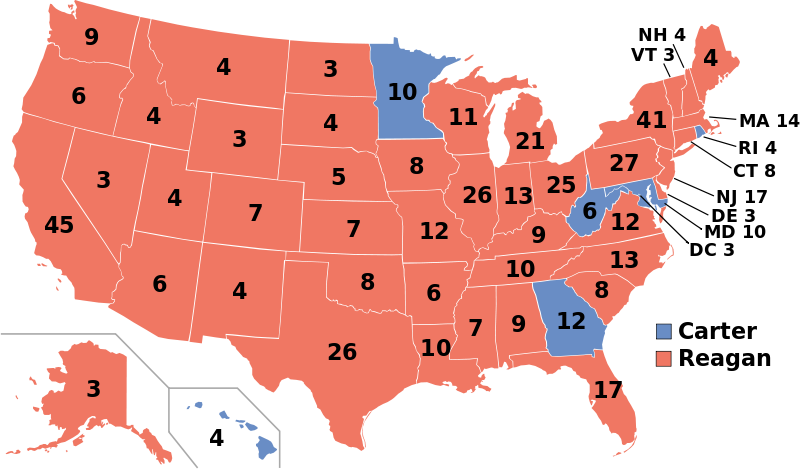
Use of Red and Blue
1980 US Presidential Election
I have a strong memory of the television coverage of the 1980 US presidential election in which Ronald Reagan won by a landslide. The only problem is, I remember the electoral map being covered in blue not red.
With the terms “Red State” and “Blue State” being part of today’s lexicon, it got me wondering why the color changed over the years. In full disclosure I have a bias: Blue is my favorite color. For some reason, I had always associated it with “the good guys” outside of the political realm. Perhaps it was the cold war threat of Soviet “reds” or my affinity for the Los Angeles Dodgers that drew me to that conclusion (Go Blue!).
As a student of history and current affairs, I’ve followed politics pretty closely but this little change seemed to sneak up on me unnoticed until probably the 2000 presidential election when it seemed almost matter of fact that red was for Republicans and blue was for Democrats. It has bugged me ever since.
The opposite is true in the rest of the world, with red being used for the left and blue for the conservative right. “Now, I am a Tory, deep blue. (Over there, they have their colors right.)” quipped Jay Nordlinger. A quick look at this Wikipedia article confirmed my suspicion and lays the proverbial blame on Tim Russet in 2000 (also see this Washington Post article).
Clearly television plays a role in all this, both in terms of what is visually compelling for the medium and how those producing television see the world (without bias of course). I suppose if television existed in 1912, we would have seen green.
Setting aside the color theory aspects (red as hot, blue as cold for example), it does produce a polarized view and may as well be black and white. I suppose this is a result of the electoral college system that awards states in whole. But as anyone with common sense will tell you, the world is full of gray and rarely just black or white.
Perhaps the other angle to look at is simple the fact there are only two parties requiring color assignments. If we consider red and blue as two of three components to the American flag, maybe its time for a third white entry to show up on the scene?